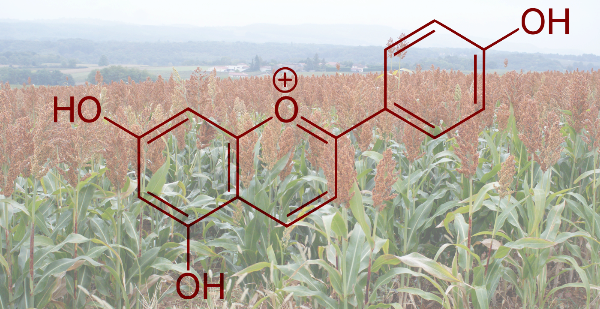
3-Deoxyanthocyanidins : From phytoalexins to photochromic pigments
3-deoxy-Anthocyanidins are molecules with an anthocyanidin backbone lacking the usual hydroxy group at position 3 on the C-ring. Some like Apigeninidin and Luteolinidin (analog to the flavones Apigenin and Luteolin respectively) are stable but relatively rare natural products that can be found in ferns and mosses, in sorghum or soybean
Apigeninidin is of profound interest due to its dual functionality as a resilient natural colorant and a potent bioactive compound. Botanically, it serves a critical ecological role as a phytoalexin, accumulating in response to environmental stress and microbial infections to protect the host plant (Xiong et al., 2019)
Beyond its physiological role, Apigeninidin has attracted substantial attention for its health benefits. Studies indicate it possesses potent antioxidant, anti-inflammatory, and antiproliferative properties, showing efficacy against cancer cell lines such as human colon carcinoma, hepatocellular liver carcinoma, and lung adenocarcinoma (Devi et al., 2011; Owumi et al., 2022).
Industrially, the compound is highly valued as a natural alternative to synthetic food dyes (Geera et al., 2012). Its superior stability during processing makes it an ideal candidate for food and cosmetic applications (Zannou et al., 2025; Xiong et al., 2019).
Additionally, Apigeninidin exhibits photochromic properties, altering its perceived color upon exposure to ultraviolet light, presenting novel opportunities for product formulation. Consequently, understanding its unique biosynthetic pathway and optimizing its synthesis remain major targets for phytochemical research (Xiong et al., 2019).
Apigeninidine is available from Extrasynthese among other amazing and rare anthocyanidins like Luteolininidin, Robinetinidin, Gossypetinidin and more...