

There are no more items in your cart

QUALOME
75
views
QUALOME: A Quantitative Metabolomic Approach to Ensuring the Quality of Botanical Ingredients.
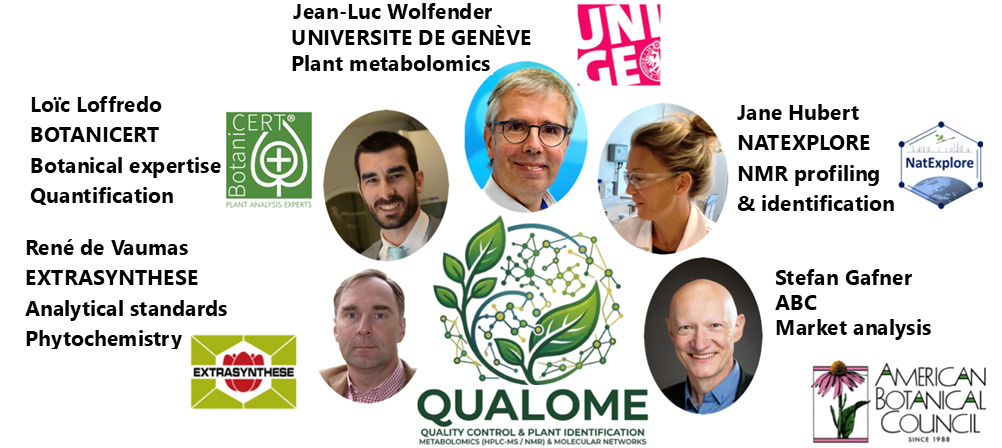
The QUALOME consortium was initiated by five individuals sharing complementary expertise in the chemistry, analysis, authentication, and quality control of natural products. This initiative was born during the Conférence Francophone sur les Ingrédients Botaniques (CFIB) 2024 in Lyon (France), following discussions on the growing challenges surrounding the evaluation of quality, authenticity, and integrity of botanical ingredients in light of the rise of metabolomic approaches.
The founding members are:
- Prof. Jean-Luc Wolfender, University of Geneva: expert in plant metabolomics.
- René de Vaumas, CEO of Extrasynthese: expert in certified reference standards, quality assurance, and analytical traceability for natural products.
- Loïc Loffredo, CEO of BotaniCERT: specialist in botanical raw material authentication, targeted quantification, and quality control of botanical extracts.
- Jane Hubert, CEO of NatExplore: expert in advanced chemical characterization and identification of major constituents in complex natural matrices.
- Stefan Gafner, Chief Science Officer at the American Botanical Council: specialist in botanical product quality and the detection of adulteration and fraud in plant-derived ingredients.
The objective, as envisioned by René de Vaumas (CEO of Extrasynthese), was to build a bridge between market needs and advances in metabolomics, with the ambition of bringing together academics and industry leaders around quality standards based on the actual composition of plant products.
Why QUALOME in a few key points ?
- Current quality control methods mainly rely on macro/microscopy, DNA barcoding, and a limited number of chemical markers or analytical fingerprints.
- These approaches only reflect a fraction of the actual chemical complexity of plant materials.
- Global supply chains increase the risk of variability, substitution, and adulteration, both for raw materials and processed extracts.
- Industry players, regulatory authorities, and consumers expect more robust tools to guarantee quality, authenticity, and traceability.
- Recent advances in metabolomics now offer the potential for a comprehensive and quantitative assessment of plant composition.
The QUALOME initiative aims to map the metabolome of fully genotyped plants using the most advanced metabolic profiling methods. The generated data will be made open-access to build reference metabolomes, designed to support the development of more holistic quality assessment approaches, including key markers quantification. Ultimately, this work aims to improve the authenticity, quality, and traceability of botanical ingredients.
During CFIB 2026 in September 2026 in Grasse, we presented a proof of concept for this approach through systematic profiling of selected plant extracts combining UPLC-UV-CAD-MS and NMR, and first results of quantification. Through this proof of concept, we demonstrate what is currently feasible in metabolomics and spark dynamic collaboration between scientific and industrial communities. A key goal was showing that it is possible to establish a clear link between genome and metabolome.
The QUALOME consortium has already shown that metabolomic approaches deliver a far superior level of detail compared to conventional methods. However, our goal goes beyond detecting adulteration; we primarily want to establish reference metabolomes for fully genotyped plants.
Ultimately, the ambition is to create an open reference resource for the entire scientific community by comprehensively mapping the metabolites present in a given plant species—hence the "-OME" suffix in QUALOME. We want to move beyond tracking just a handful of standard markers defined in pharmacopeias or isolated literature to provide comprehensive and informative metabolic fingerprints.
For instance, while extensive literature exists for Arnica, data remains scattered. Our goal is to consolidate this information within a unified analytical workflow to produce an exhaustive metabolic fingerprint.
This work will be pursued in the coming years and the project will be keen to welcome new stakeholders.
In the short term, our priority is validing three key steps:
- Proof of concept validation.
- Concrete industrial implementation.
- Recognition by relevant regulatory authorities.
In the longer term, we envision establishing a dedicated organizational structure, such as a foundation, to unite academic and industrial leaders, generate and share data, and maintain an open-access database of plant reference metabolomes.